Showing posts with label Tramps. Show all posts
Saturday, 4 August 2012
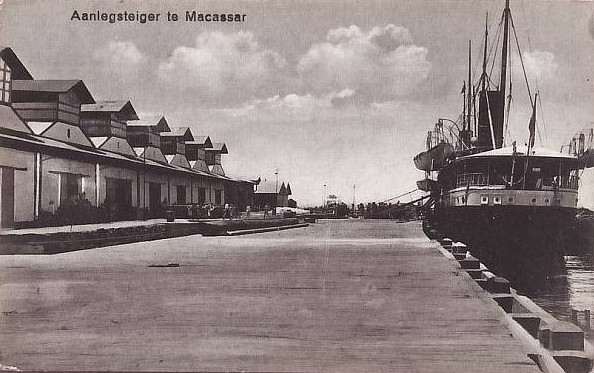
Macassar, Indonesia
Sometimes spelled Macassar, Mangkasar. Provincial capital of South Sulawesi, Indonesia, and the largest city on Sulawesi Island. Located on the southwest coast of the island of Sulawesi, facing the Makassar Strait.
There is no record of Lowry visiting city on his voyage to the Far East in 1927. Lowry refers to the city in his short story 'Tramps'; "Now when I was in Macassar.." (Pg. 4). Lowry also refers to the city in a letter to John Davenport dated 27th October which contains many references to Richard Eberhart's poems 'Caravan of Silence' and A Bravery of Earth though Eberhart does mention the city; "a Persian too - he longed for the friendly lights against the night in his home-town Macassar or Basia." (Collected Letters Vol 1 Pg. 74). Lowry may have been influenced by Conrad's reference to the city in his short story 'Freya of the Seven Isles'; "the prettiest, and perhaps the cleanest-looking, of all the towns in the Islands." Lowry also makes reference to a "Maccaser" in his novel Ultramarine; "In Persia it was, Macasser the Sultan came aboard with all his harem under bloody umbrellas." (P.70). There was a Sultanate of Macassar which maybe what Lowry is making reference to in his novel. Again there maybe a connection to Conrad as Sultans occur in many of his short stories.
Friday, 13 July 2012
Iloilo, Philippines
Iloilo is a province of the Philippines located in the Western Visayas region. Iloilo occupies the southeast portion of Panay Island and is bordered by Antique Province to the west and Capiz Province and the Jintotolo Channel to the north. Just off Iloilo's southeast coast is Guimaras Province, once part of Iloilo Province but now a province in its own right. Across the Panay Gulf and Guimaras Strait is Negros Occidental. Iloilo's capital is Iloilo City though the city itself is independent and not governed by the provincial government of Iloilo.
Lowry mentions Iloilo in his short stories 'Tramps' and 'Goya The Obscure' and later in Ultramarine; "……his tattooed arms (where had they been tattooed, ….Iloilo?)" (Pg. 26).
There is no documentary evidence to suggest that Lowry visited Iloilo as part of his 1927 voyage to the Far East. It would appear that Lowry's mention of Iloilo is perhaps part of a youthful obsession with the "exotic East" which, manifested itself in the composing of the song 'I've Said Goodbye to Shanghai' with his Cambridge musical partner Ronald Hill. The reference to the Iloilo may have been influenced by Lowry's reading of Richard Eberhart's poem A Bravery of Earth published in 1930. Eberhart's poem reflected his experiences at Cambridge University and his time as a ship's hand in the Far East. In a letter Lowry wrote to John Davenport dated 27th October 1930; "The third - (Richard Ghormley Ebehart!), unamazed in meditation looked up from Persia - more likely sailing down the coast by Iloilo, Zamboanga, Sabang, anywhere, Eberhart Icarus at this time". (Collected Letters Vol 1 Pg. 73-74).
Monday, 7 May 2012
E.E. Kellett 1864-1950
He was English master at The Leys School, Cambridge when Lowry attended. He was a master from 1889-1924. Educated at Kingswood Scool and a scholar and prizeman of Wadham College, Oxford. He had an "extraordinary memory and knowledge of any man I have ever met. He was a classic, mathematician and English man of great resource and teaching power, if a boy wanted to be taught. He was a light versifier of merit and wrote for Punch and other journals." J.H. Hays quoted in Derek Baker's book on The Leys; Partnership in Excellence. He also acted as a referee for Caldicott School which Lowry also attended in preparation for the The Leys.
He wrote many books including Story of Myths 1927, The Northern Saga 1929, The Whirligig of Taste 1929, Fashion in Literature 1931, Story of Religions 1934 etc. He appears to have had connections with several literary figures during the 1920's and 1930's including the Woolf's as he had work published in their Hogarth Press. He also had links to the magazine Life and Letters.
He lived after retirement at 5 Woodville Road, Blackheath. Lowry spent several months in Blackheath being tutored by Kellett for the entrance examination to Cambridge between 1927 and 1928. Kellett had considerable knowledge of Scandinavian mythology which may have have been an influenced Lowry who was already obsessed with Norway. There is also a possibility that Kellett introduced Lowry to modern Scandinavian literature by Bang, Hamsum, Jensen and even Grieg. The link, as yet unconfirmed, being that all the novels were translated by A.G. Chater. Another interesting link is that Kellett wrote a book Literary Quotation and Allusion 1933, a subject matter used to great effect by Lowry in his work.
Lowry refers to his time with Kellett in his novel Under The Volcano when Hugh recalls; "He was already entered at Cambridge for a year or so hence. He had not, however, the slightest intention of going there. The prospect of it, for some reason, he dreaded only less than being stuck meantime at some crammer's. And to prevent this he must act swiftly." (Pg. 160).
Tsjang-Tsjang
A fictional sea port that occurs in Lowry's works including 'Tramps' and Ultramarine. Commentators including Gordon Bowker have identified the sea port asYokahama, Japan probably because of the Japanese references used and that was also the final port on Lowry's 1927 Far East voyage.
However, close reading identifies the sea port as Dairen (now Dalian) in China formerly Manchuria then occupied by Japan and visited by Lowry in 1927. The origins of the words Tsjang-tsjang may be the Dutch intepretation of Chinese words with the English equivalent of Chang Chang.
Other commentators have also identified the port as being in Manchuria; "Now, out of the mortuary of expired novels comes a re-edition of this first book by Malcolm Lowry, ... with the tough talk and the one- track sport of the foc's'le hands in the disenchanting Manchurian port of Tsjang-Tsjang. ..." The Canadian Forum: a monthly journal of literature and public affairs: Volume 43 and Barry Wood Malcolm Lowry: The Writer and his Critics Pg. 5.
Dairen is actually mentioned 5 times by name in the Ultramarine but there are many descriptions of the port which establish the fictional Tsjang Tsjang as Dairen (See entry for Dairen for full details); "At Tsjang-Tsjang, he supposed, the same interminable performance would be gone through as before; the usual stream of hawkers would surge on to the ship; stevedores would clamber up the side from lighters, or swing in on the derricks; the winchmen would soon be seated on their straw mats.." (Ultramarine Pg 16); "This evening we reach Tsjang-Tsjang.. (Ultramarine Pg. 18); "They were now sailing into Tsjang-Tsjang harbour.." (Pg. 29); "Tsjang-Tsjang was by now all around and over the Oedipus Tyrannus, with what he took to be rice fields, formed in steps, sloping perilously down to the sea: the port itself, grouped a the bottom of the cliffs, was every moment growing larger.(Ultramarine Pg. 30); Janet Travena addresses a letter to Dana Hilliot in Tsjang-Tsjang (Ultramarine Pg. 168); "Eight hours out of Tsjang-Tsjang (Ultramarine Pg. 169).
Friday, 4 May 2012
Zamboanga
Lowry mentions Zamboanga, a long, semicircular peninsula located in northwestern Mindanao, Philippines, in his short stories 'Tramps' and 'Goya The Obscure' and later in Ultramarine; "……his tattooed arms (where had they been tattooed, ….Zamboanga?)" (Pg. 26).
There is no documentary evidence to suggest that Lowry visited the peninsular as part of his 1927 voyage to the Far East. It would appear that Lowry's mention of the peninsular is perhaps part of a youthful obsession with the "exotic East" which, manifested itself in the composing of the song 'I've Said Goodbye to Shanghai' with his Cambridge musical partner Ronald Hill. The peninsular features in Joseph Conrad's novel Lord Jim and is possible source as he read the book in his youth. The reference to the peninsular may also have been influenced by Lowry's reading of Richard Eberhart's poem A Bravery of Earth published in 1930. Eberhart's poem reflected his experiences at Cambridge University and his time as a ship's hand in the Far East which would have had obvious appeal to Lowry. Lowry wrote a letter to John Davenport dated 27th October 1930; "The third - (Richard Ghormley Ebehart!), unamazed in meditation looked up from Persia - more likely sailing down the coast by Iloilo, Zamboanga, Sabang, anywhere, Eberhart Icarus at this time". (Collected Letters Vol 1 Pg. 73-74).

Here is an interesting travel movie 'Zamboanga' made in 1936
"Zamboanga" was directed by Marvin Gardner in his native Philippines in 1936. His screen name was Eduardo De Castro. Thought lost forever, it was found in 2003? by Philippine filmmaker Nick de Ocampo at the US Library of Congress. (The copy came from Finland, hence the subtitles.) It stars Fernando Poe, Sr., the father of Fernando Poe, Jr., Philippine actor and presidential candidate. It is the oldest Filipino feature film known to exist. It was produced by Americans Tait and Harris and intended for American audiences. I have read that it was the first Filipino film entered in the Oscar Awards, but I'm still researching that. I had never even hoped to see any of my grandfather's work, as we thought it was all destroyed during WWII. The original film is now back in the Philippines. Nick included "Zamboanga" in his book, SineGabay: A Film Study Guide. He was kind enough to send some copies of the movie to my family. Read more
So We Live Forever Taking Leave
So We Live Forever Taking Leave was Lowry's original title for his short story ‘In Le Havre’ According to Gordon Bowker, Lowry envisaged a series of linked short stories plus a novel, In Ballast to the White Sea, divided into four themes - the the four elements, water, earth, fire and water, projected by Lowry in a letter to Jan Gabrial dated July 1934. (Pursued By Furies Pgs. 181-82)
The titles of the short stories in the proposed collection were as follows:
1. Bulls of the Resurrection
3. Zodiac
4. Metal
5. Cafe Chagrin
7. A Goddam Funny Ship
10. An Economic Conference
11. In Ballast to the White Sea
The only surviving copies of the above are 1, 4 (revised title '30th June 1934'), 6, 8, 9, 10 and 11.
Tramps
'Tramps' is a short story written by Malcolm Lowry that remains unpublished. (University of British Columbia Lowry Archives 25-9). Originally conceived as part of the collection entitled So We Live Forever Taking Leave.
Gordon Bowker says that the story was written at Inglewood after Lowry’s return from the Far East in 1927 along with ‘China’ and ‘Enter One In Sumptuous Armour’ (Pursued By Furies Pg. 139). Judging by the style of the story, we must assume that this was one of the earliest pieces produced by Lowry after his trip to the Far East. The story has none of the modernist influences of later works based on the voyage such as ‘Goya The Obscure’.
Perhaps it can be dated pre-1930 possibly before he went to Blackheath or Cambridge, which would date it as Summer/Autumn 1927. The story has under tones of Lowry’s reading of Scandinavian literature from this period such as Nordahl Grieg’s The Ship Sails On, Herman Bang’s Denied A Country and the works of Knut Hamsun. There is mention of several Far Eastern locations – Singapore, Zamboanga, Manila, Makassar and Tsjang-tsjang. Lowry visited Singapore on 13th June 1927.
There is no documentary evidence that he visited either Zamboanga or Manila both in the Philippines or the Indonesian city of Makassar on the Far East voyage. Lowry also mentions the island of Zamboanga in ‘Goya The Obscure’ published in 1930 . These Far Eastern references may have been influenced by Richard Eberhart’s poem A Bravery of Earth published in 1930. Richard Eberhart’s poem reflected his experiences at Cambridge University and his experience as a ship's hand in the Far East. Therefore, the Far Eastern references may point to a later date possibly 1930 for the version held at University of British Columbia. Tsjang-tsjang is Lowry’s first use of this fictive Eastern name for the port of Dairen which he visited in 1927 reappearing in his first novel Ultramarine.
The story is set on a pier on an unnamed river where two sailors reminisce about their adventures at sea while looking at two “tramp” steamers” tied up a the pier. The sailors’ talk meanders through memories both real and imagined which possibly reflects Lowry’s experiences on his Far East voyage of overheard conversations between the crew. Lowry attempts to unearth “the very saga of the sea” which lies hidden in memory and dream.
The idea of memory and how it distorts also has parallels in ‘China’ another short story from this period. Lowry appears to be formulating the premise that once you have made a voyage then it is more easy to imagine other voyages: “The tree of memory was here. And how much more swiftly in his mind, without words, a voyage could be anywhere. How easily he was transported to places even he had never known”. Lowry plays with the idea of memory and reality again in the short story ‘China’.
The sailor continues his fantasy as the ship voyages out in dream perhaps reflecting Lowry’s boyish fantasies of the East – meeting a sultan and his harem or trafficking in strange merchandise which are straight out of Lowry’s youthful reading of boy’s magazines. Lowry concludes; “But deep within you, rusted into your memory, buried beneath dust and ashes, your true voyages still trace eternally their course, where shipwreck, sudden death, the very saga of the sea lies hidden”, which would appear to be a precursor for Lowry’s incomplete epic The Voyage That Never Ends.
The two sailors argue before eventually falling asleep during which time the two ships take up their conversation in their dreams, repeating exaggerated and distorted memories. Gordon Bowker has noted “it sounded like Lowry conversing ironically with himself” (Pursued By Furies Pg. 139). The exaggeration of one of the sailors telling yarns is reminiscent of Lowry’s own bar-room tales he repeatedly told after his voyage. One sailor says; “You’re getting so that you don’t belong to anything. Just now you may have been lying about your nationality, just for fun, but soon you’ll have difficulty remembering your name.” This reflects Lowry’s own feeling of isolation both at sea and on his return, his use of Norwegian personas in later stories starting with his alter ego Dana Hilliot in Ultramarine and perhaps the loss of memory through drink.
The story has some striking imagery, which has become Lowry’s trademark as a writer; “rust traced a map of the world on their hulls”, “the first searched again within the battered thesaurus of the past”; “the ships had closed their faces to the dark” as Lowry transfers the memories of voyaging, ship wrecks and sudden death from the sailors to the ships. The names of the ships are worn off which appears to symbolise their loss of identity similar to one of the sailors forgetting their names. The names of ships both real and imagined continually arise in Lowry’s work.
The story is one of the first in which Lowry makes use of Scandinavian references, which may reflect his time in Blackheath studying with E.E. Kellett for entry to Cambridge University in 1927/28. Kellett published The Northern Saga in 1929, which studies Norse myths. It is possible that Lowry was influenced by Kellett’s studies. Kellett may also be the source of Lowry’s reading of Scandinavian literature such as Grieg, Berg and Hamsun. There are references to shoes being bought in Norway, Norway being a fine country; the Queen of Norway being George V’s sister – Princess Maud of Wales.
Maud was Queen of Norway as wife of King Haakon V11; “Denmark’s the biggest country in Norway” refers to the Kalmar Union in which Norway remained with Denmark until 1814, a total of 436 years. During the national romanticism of the 19th century, this period was by some referred to as the "400-Year Night", since all of the kingdom's royal, intellectual, and administrative power was centred in Copenhagen in Denmark; there is reference to Schleswig-Holstein belonging to the Danes - Schleswig and Holstein have at different times belonged in part or completely to either Denmark or Germany, or have been virtually independent of both nations. The referenda on nationality following the First World War would have still been within Lowry’s memory and is an early example of Lowry’s interest in politics/history being incorporated into his work.
There is also an early example of Lowry referring to real ships – R.M.S. Mauretania an ocean liner operated by Cunard Line which Lowry as a youth probably have seen the in the River Mersey.
Lowry uses the term Western Ocean, probably picked up from his reading of Joseph Conrad to describe the Atlantic. Lowry makes reference to Dairen but uses the Russian name Dalny for the port; “loaded bulk oil in Dalny during the Russo-Japanese War”.
Lake Charles in Louisiana is referred to as a ”spindle head”. There is no record of Lowry visiting the port in on his 1928 voyage to America to see Conrad Aiken but this may have been how he knew the port. Lowry uses several nautical terms or slang which re-occur in Ultramarine and his other stories of this period – hausers, wirerunners, ringbolt, ticket, “went deep water”, windbag, bosun, to the coaltips, “an old laundry boat”, “old canvas dodger”, “picking up washing”, “sail for sour apples with yards on the backstays, “not an old haystack like this”, “down to spindleheads”, “swaggle bellied tug”. Some of these must be based on his Far East trip but others must be from his reading of magazines such as Blue Peter mentioned in Ultramarine.
See my post Just A Dirty Old Tramp for source of song sheet used to illustrate post.
Subscribe to:
Posts (Atom)


.jpg)