Showing posts with label Japan. Show all posts

Saturday, 8 September 2012

Moji, Japan


Moji-ku is a ward of Kitakyūshū, Fukuoka Prefecture, Japan. It is the former city of Moji which was one of five cities merged to create Kitakyūshū in 1963. It faces the city of Shimonoseki across the Kanmon Straits between Honshū and Kyūshū.


Moji was first made into a port by Suematsu Kenchō with the financial backing of Shibusawa Eiichi in 1889. It was chiefly used for the transportation of coal, though there is a traditional song about the sale of bananas imported into Moji from Southeast Asia which survives to this day (Banana no tataki-uri). Moji was also the departure point for many troops in the Russo-Japanese War who were ferried across to Korea.


Lowry refers to the port in his novel Ultramarine when Norman is warning Dana about contracting venereal disease when he goes ashore in Tsjang Tsjang (Dairen); "Voyage before last, in Muji, it was, I picked up, the finest dose you ever saw, voyage before last in the Maharajah - she's lying in this port now" (Pg. 34) and again when the crew of Oedipus Tyrannus are talking about how Smithy contracted venereal disease in Moji; "got it in Muji he had, and never said damn all to anybody.." (Pg. 61).


There is no record that Lowry visited the port on his 1927 voyage to the Far East. Lowry was familiar with J. Johnston Abraham's The Surgeon's Log, which features a visit to the port where his ship takes on coal (Pgs. 122-144), which may have inspired him to feature the port in Ultramarine. Or Lowry may have known that Moji was a regular port of call for Blue Funnel ships to take on coal on trips to Japan.


Wednesday, 8 August 2012

Satsuma Ware Grand Revival


Lowry refers to 7 times to signs for Satsuma Ware. Grand Revival in Chapter 3 of Ultramarine as Dana walks around Tsjang Tsjang (Dairen). (Pgs.85/99/104/109,116 and 118).

Satsuma ware sometimes referred to as "Satsuma porcelain," is a type of Japanese earthenware pottery. It originated in the late 16th century, during the Azuchi-Momoyama period, and is still produced today. Although the term can be used to describe a variety of types of pottery, the best known type of Satsuma ware has a soft, ivory-colored, crackled glaze with elaborate polychrome and gold decorations

Satsuma ware originated when the Shimazu prince of the Satsuma domain in southern Kyūshū abducted skilled Korean potters after Toyotomi Hideyoshi's Japanese Invasions of Korea to establish a local pottery industry. After display at the international exhibition in Paris in 1867, it proved popular as an export to Europe.

"The Grand Revival" refers to the interest in the art of the village potter was revived in a folk movement of the 1920s by such master potters as Shoji Hamada and Kawai Kajiro. These artists studied traditional glazing techniques to preserve native wares that were in danger of disappearing. Later the Satsuma style was also duplicated by the potters in Kyoto, Tokyo, Osaka, Kobe, and Kanazawa. Stoneware and pure white porcelain were the favored mediums for Satsuma .

Lowry may have seen signs for the sale of Satsuma Wares in Kobe on his 1927 voyage to the Far East. He may have also seen signs for them in Dairen e.g K. Suzuki & Co.


Sudoh and Co.


Lowry refers to an advert by the K. Suzuki & Co. in his novel Ultramarine during Dana's drift around Dairen in Chapter 3 when Dana enters a cinema sees businesses being promoted on the screen. It is not impossible that adverts for the Japanese mainland may have been advertised in Japanese occupied Manchuria. Or it might be Lowry simply transposing Kobe into Dairen:

Sudoh and Co. - manufacturer and exporter of curios and vases, porcelain and satsuma ware, teas sets, screens, bronze wares, pearls.....Cloisonne lacquered wares, tortoiseshell wares. 10, 11, & 12 Chickaramachi 4 chome, Nagoya, P.O. Box No. 2 Akatsuka. Tel. 586 Higashi. Factories: Chikusa-cho, Nagoya, and Mino, Seto, Owari.... We deal Production of our Own and all Round value Call and see them Everything so Lovely we'll give you A1 satisfaction Inspection invited call and see them Now is best chance.

The spelling, punctuation etc are Lowry's. It is possible that he either memorised and noted later hence mistakes, noted at the time hence mistakes or perhaps noted after reading a pamphlet or book. Lowry may have picked up a pamphlet similar to Some Suggestions for Souvenir Seekers produced by the Japanese Government Railway. The pamphlet gives descriptions and photo examples of numerous types of pottery and porcelain, including where they were made, it features a list of Souvenir Dealers. The names are given in English without the Japanese equivalency since the pamphlet was aimed at English-speaking tourists.

K. Suzuki & Co. (Kichigoro Suzuki) was a Japanese manufacturer and dealer in Bishu Porcelain.The head office was No. 10, 11, & 12 Chikaramachi 4 chome, Nagoya.Tel. No. 586 Higashi L. D. They had a branch office at No. 8 Kitanagasa-dori 3 chome, Kobe. Tel. No. 815 Sannomiya L. D. Telegraphic Address: Yamasuboshi, Kobe Codes Used: A, B, C, 5th Edition & Private.

Suzuki Kichigoro was a manufacturer and dealer in Bishu (Owari) (present day Aichi) porcelain ware. Bishu is another name for Owari and Bishu porcelain is Owari porcelain and regarding Bishu (Owari) porcelain, it is of a very white color.

The artist Suzuki Kichigoro was a highly noted sculpturer and carver.  He was a very diverse artist and worked in several mediums and mixed his mediums: ivory, tortoise shell, cloisonne, lacquer, copper, gold, silver, atimony, bronze, zinc, leather, wood, bamboo, and porcelain.  His created art works were: sculptures, vases, trays, tobacco containers, mantel ornaments, card plates, censers, tablets, boxes, match boxes, paper weights, pen plates, dust pans, flower pots, ladies bags, dresser ware, cloisonne ware, and makiye ware.


Tuesday, 7 August 2012

Sonnomiya 2580


Sannomiya  is a district of Kobe, Japan. Today, it is the biggest downtown area in the city.

Before the 1920s, Sannomiya was just an edge of the city. The major downtowns were Motomachi and Shinkaichi, which are west of Sannomiya. However, after Sogo Department Store moved to the place in front of Sannomiya Station from Motomachi in 1933, the area started to develop rapidly.

Lowry refers to a telephone number Sonnomiya (Lowry's spelling) 2580 in Ultramarine for the O Hiro Bar Yamagata-Dori which would have been impossible as Yamagata-Dori is in Dairen. Lowry possibly noted the number while watching a film in Dairen as he notes it after referring to adverts for Kobe on the screen while Dana is watching a film (Pg. 98)

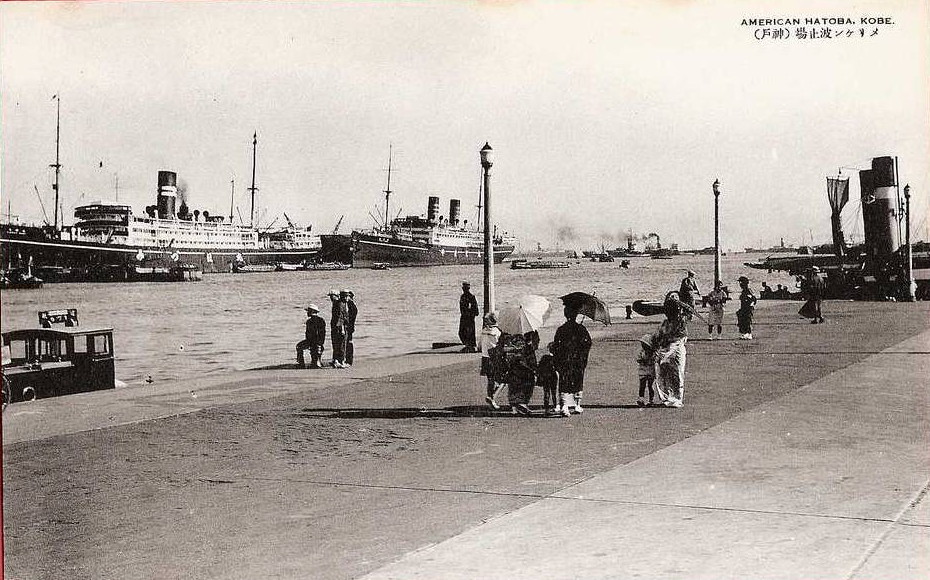
American Hatoba (Pier), Kobe


American Hatoba (Pier), for many years the main pier in Kobe. Until 1922, large ships couldn’t dock in the harbor, so the hooting launches maneuvered continuously through the multitudes of junks and other small vessels to shuttle passengers and their luggage between anchored ships and the pier. As the harbor developed, American Hatoba lost its importance as place of entry and in 1987 the pier finally vanished as it was incorporated into Meriken Park, Meriken being the local pronunciation of American.


Lowry refers to the pier during Dana'a drift around the red light district of Dairen in his novel Ultramarine - while Dana is waiting for a film to start adverts appear on the screen; "The American Hatoba, the Oriental Hotel, and the Kyo-Bashi...Oh these infernal advertisments on the screen!" ( Pg.98). It is not impossible that adverts for the Japanese mainland may have been advertised in Japanese occupied Manchuria. Or it might be Lowry simply transposing Kobe into Dairen.


Monday, 6 August 2012

Oriental Hotel, Kobe


The Oriental Hotel originally opened in Kobe, Japan in 1870. The hotel was at the junction of Kyōmachi-suji Avenue and Nakamachi-dōri Street in the former Foreign Settlement (Concession) in Kobe.The above postcard shows the third generation building opened in 1907 and destroyed in 1945 in WW2. 1945.

Lowry refers to the hotel in his novel Ultramarine during Dana'a drift around the red light district of Dairen - while Dana is waiting for a film to start adverts appear on the screen; "The American Hatoba, the Oriental Hotel, and the Kyo-Bashi...Oh these infernal advertisments on the screen!" ( Pg.98) and again "......I thought, as we passed an hotel, the Oriental, blazing with light." (Pg. 100). It is not impossible that adverts for the Japanese mainland may have been advertised in Japanese occupied Manchuria. Or it might be Lowry simply transposing Kobe into Dairen.

The photographs below circa 1930 as the hotel would have been when Lowry visited Kobe.


Kobe, Japan


Kobe is the fifth-largest city in Japan and is the capital city of Hyōgo Prefecture on the southern side of the main island of Honshū, approximately 30 km (19 mi) west of Osaka. Kobe did not exist in its current form until its founding in 1889. Its name comes from "kanbe" an archaic title for supporters of the city's Ikuta Shrine. Hyōgo-ku or Ōwada Anchorage or Hyōgo Port is an area is the historical heart of the city. Shinkaichi in Hyogo-ku was once the commercial centre of Kobe, but was heavily damaged during World War II, and since Hyogo-ku has lost much of its former prominence.


Kobe Port was first opened to foreign trade in 1868. At that time it had no wharfs to serve large vessels so loading and offloading had to take place offshore. This situation persisted for a long time.


Finally in 1907, due to dramatic increases in trade, plans were made for extensive new port facilities. During the so-called First Stage Kobe Port Development Plan the Shinko (New Harbor) piers No. 1 through No. 4 were constructed (1907-1922). In 1919, work began on the Second Stage, which included the construction of Shinko piers No.4 (East) through No.6, Naka Pier and Hyogo Piers (No.1, No.2 Piers). This was completed in 1939. Kobe had now the largest berth in Japan, with a depth of 12m.


Lowry visited the port between 28th June and 1st July 1927 on his voyage to the Far East. He had obscure reference to the port in the 1927 poem 'The Glory of the Sea':

'Where's Chang tonight? he asked the Third;
'It's past the time he came off watch:
Half-hour ago eight bells I heard;
I've got a cake of Kobe trout,
Tinned, by crimes! I bed your Scotch-'
'Chang? Chang's dead: his heart came out.'

1914  Map of Kobe: 1. Sannomiya Station (currently Motomachi Station); 2. Motomachidori; 3. Sakaemachidori; 4. Higashi Yuenchi Park; 5. Oriental Hotel; 6. Kaigandori; 7. Customs House; 8. American Hatoba.

Lowry also refers to the old port of Kobe during Dana'a drift around the red light district of Dairen in his novel Ultramarine - while Dana is waiting for a film to start adverts appear on the screen; "The American Hatoba, the Oriental Hotel, and the Kyo-Bashi...Oh these infernal advertisments on the screen!" ( Pg.98). It is not impossible that adverts for the Japanese mainland may have been advertised in Japanese occupied Manchuria. Or it might be Lowry simply transposing Kobe into Dairen.


It is possible that Lowry experienced the incident with the Japanese prostitute in Kobe as described by Joseph Ward in a letter to the Liverpool Daily Post dated 14/4/1962. Ward  says:

....he seemed a lost soul and his reproductive organ was certainly in the back row, it was a teeny-weeny object that disgusted a Japanese geisha girl to such an extent as to frustrate her into impolite abuse.


Stan Hugill describes Kobe in Sailortown as follows:

With some seamen Kobe was Number One, and although, perhaps, it did not have the variety of sailor entertainment offered in Yokohama, still had plenty of girls and bordels. Perhaps the reason why some seamen preferred Kobe to Yokohama was the fact that most girls here wore Western dress. 


The main street, the Motomachi, was lined on both sides with small and large bars, cafes and dancehalls, the numbers of "garus" or girls found in them being legion. Down the alleyways, too, more dives were to be found, and as well as dives, Kobe was famous for its so-called Sex Stores.....


The bars and dives best known to seamen were the Honey Drop, Union Bar, Kimi Bar, Golden Bat, the Frisco, Fuji Bar, Hana Bar, Havana Bar, Academy Bar, Rose Bar, Young Bar, Yokohamate, and Boston Bar. 


The native kuruwa, called Fukuwara or"Lucky Moor", was to be found in Hyogo the older port adjacent to Kobe - near to Theatre Street of Shinkaiichi. It was a replica of the one in Yokohama, but a bit livelier perhaps, since it was situated in a busy market and theatre district. The biggest houses were the Fukanariro and the Daikichiro. In these more modern times, however, what with the competition of the Western-dressed dance hostesses and the more Western-styled bars, these old fashioned native brothel areas were not patronised as much by seamen as they were olden times. 


Even if one wanted to go to such a place and said tho the Japanese taxi-driver, "Yoshiwara", it was usual for the driver, who had probably driven hundreds of sailors to bars and brothels, and who believed than that the latter did himself, to take his customer to a Western-styled dive. The girls in this district charged 2.5 yen a "short time", 5 yen an hour, and 8 yen "all night", the yen at this time being worth 1s. 2d." (Pgs. 334-335).


Friday, 11 May 2012

Miike, Japan


In 1902, construction began on Miike Port on the Ariake Sea, a body of water known for extreme tidal variations. Work was completed and the dock basin flooded in March 1908. With a ship channel extending 1,830 meters out to sea and lock gates to maintain the water level of the ship dock at 8.5 meters or more, the new port was equipped to handle 10,000-ton vessels and their cargo. The port gate consisted of double doors, each 12.17 meters wide, 8.84 meters tall, 1.20 meters thick, and produced by Thames Civil Engineering Co. At the points of contact, they were made of a special dense hardwood resistant to water and insects, which had been imported from South America. A variety of related facilities were built in conjunction with the port’s opening, including the Nagasaki Customs Miike Branch and Mitsui Minato Club, where ships’ officers were entertained. When the Miike Coal Mine Industrial Railway was extended as far as Miike Port in 1905, the port became part of an integrated system encompassing coal extraction, rail transport, and marine shipping. To this day, Miike Port continues to play an important role as an industrial port. The Modern Industrial Heritage Sites in Kyushu and Yamaguchi


On arrival at Miike, the pilgrim could not but admire the skill and enterprise displayed by the Mitsui Co. in the development of a flat shore, with shallow water and extensive mud banks, into a magnificent wet dock and half-tide basin, the latter 127 acres in area from which two parallel breakwaters, each 9,000 feet long from the dock gates, form a channel having a minimum depth of 18 feet at L.W., M.S.T.

The dock gates are a fine piece of engineering, maintaining a minimum depth of 28 feet within the dock, which latter is 32 acres in area.

The entrance is 66 feet wide, each gate weighs 90 tons and is operated by hydraulic power. Sydney Shadrach Kemp Leaves from the Diary of a Pilgrim: September 24th, 1917: A trip to Miike


Blue Funnel ships stopped to refuel here in the 1920’s. It is not recorded that Lowry‘s ship stopped here on his the Far East voyage in 1927. Lowry may have been told about the port and its myriad of brothels.  Joe Passalique has contracted syphilis in the brothels of port in ‘Goya The Obscure’ 272. One of the crew of the Oedipus Tyrannus in the novel Ultramarine says; "reminds me of the time in Miki when-" (Pg. 47); the brothels occur again in Under The Volcano; " The bunkers, loaded at Miki - a black coaling port calculated to fulfill any landsman's conception of a sailor's dreams, since every house in it was a brothel, every woman a prostitute, including an old hag who did tattos" (Under The Volcano Pg. 167). This is confirmed by Hugill; “Miike must be the only place in the world where the seamen had to walk through the brothel area to get out of the dock gates!” Stan Hugill Sailortown Pg.335. In the 1920’s, the main street had many bars such as the Blue Funnel Bar, the Lighthouse, the Ship Bar, the Korean Hotel, and the Benisusume Cabaret, all geared to please the visiting seamen. There was “a sort of Museum of Anatomy, with crude pictures outside and cruder wax figures within” Stan Hugill Sailortown Pg. 336. The museum echoes the one in Dairen visited by Dana Hilliot in Ultramarine Chapter 3; and the one Lowry visited  in Paradise Street, Liverpool.