Showing posts with label West Kirby. Show all posts

Sunday, 5 August 2012

Hydropathic Hotel West Kirby


A former hotel on Marine Parade, West Kirby opened circa 1896 which was demolished in 1972 and replaced with town houses.


Advertised as the "Sanatorium of the North - Magnificent Hydro on the Banks of The Dee" The baths were described as Turkish, Russian, Vapour, Electric etc. The hotel provided packing rooms, salt water plunges, hot, cold and sea water, massage and medical gymnastics offering "splendid inland and sea - charming views of Wales". Tennis, boating and golf at Hoylake Golf Links was advertised.

Lowry refers to the hotel in his novel Under The Volcano; "Only at week-ends did a certain disadvantage appear in their site: although the season was drawing to a close and the grey hydropathic hotels on the promenades were emptying, the golf course was packed all day with Liverpool brokers playing foursomes." (Pg. 23).


Tuesday, 17 July 2012

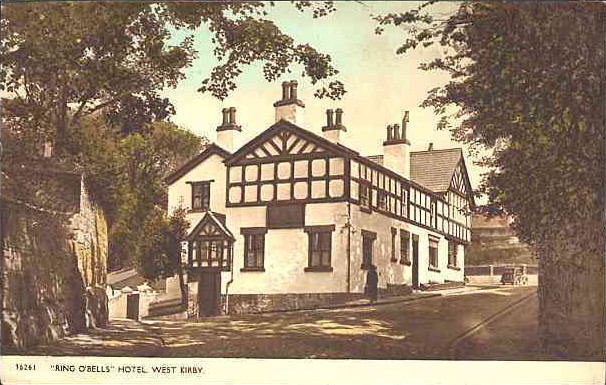
Ring O' Bells, West Kirby, Wirral


The Ring O' Bells was a public house in Village Road, West Kirby. The pub was rebuilt in 1810 on the site of an older pub of the same name. The cellars are cut into sandstone and extend underneath Village Road. The rock has been shaped to hold the barrels of ale, with a drainage channel below. The pub once had a bowling green and tennis courts. The pub is now a restaurant.


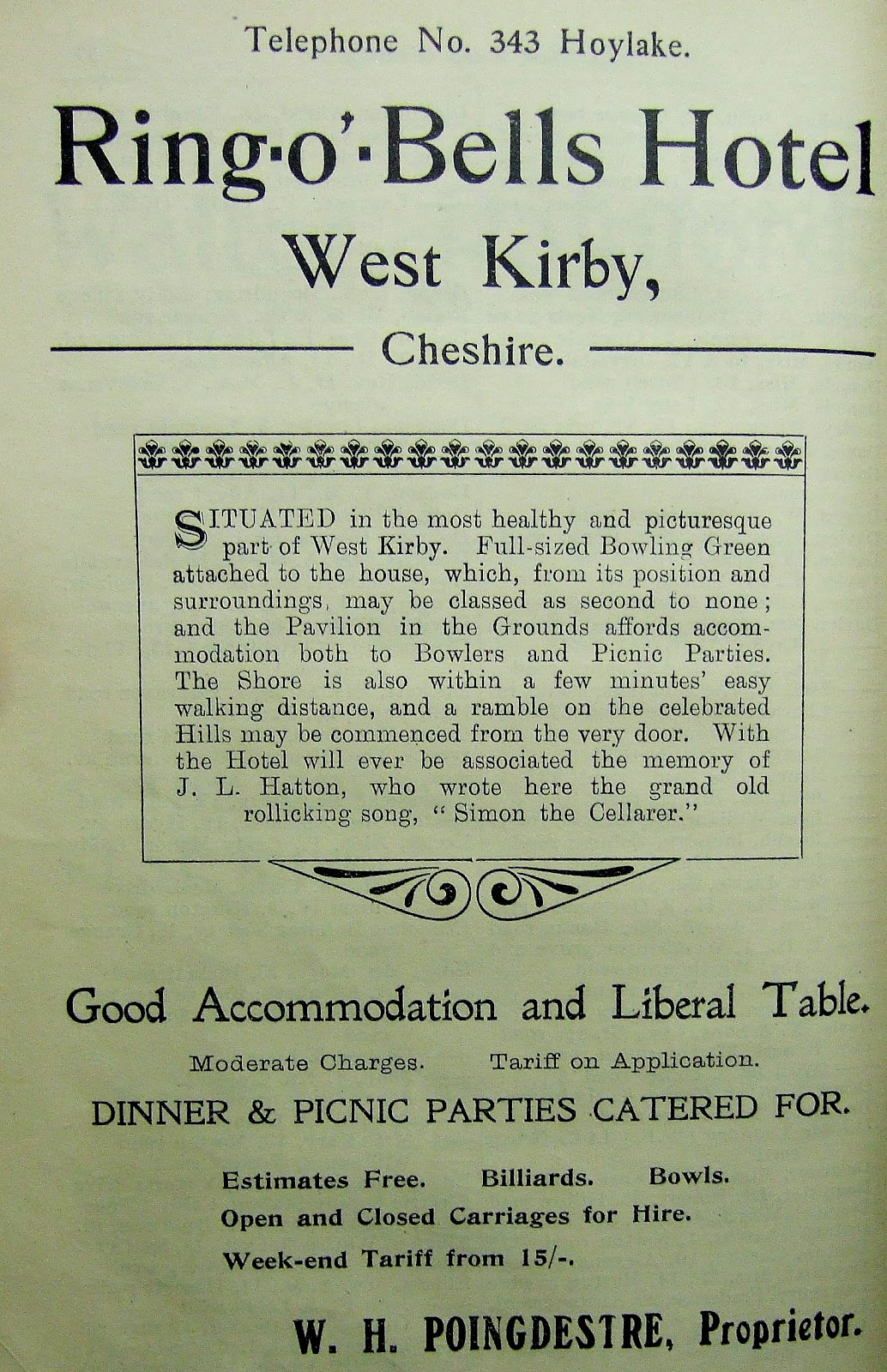
Situated in the most healthy and picturesque part of West Kirby. Full-sized Bowling Green attached to the home which, from its position and surroundings, may be classed as second to none; and the Pavilion in the Grounds affords accommodation both to Bowlers and Picnic Parties. The shore is also within a few minutes easy walking distance, and a ramble on the celebrated Hills may be commenced from the very..With the Hotel will ever be associated the memory of J.L. Hatton, who wrote here the grand old rollicking song, 'Simon the Cellarer' (Advert Porter's Directory for West Kirby, Hoylake etc 1901) 

This hotel has proved a port of call and pleasant resting place for such national characters as the poets SHELLEY and KEATS, also the artist TURNER when painting his pictures of sunsets on the River Dee. It was the source for that famous song "SIMON THE CELLARER", which was composed here.

This famous Hostel still retains its pleasant and old time atmosphere of fragrance and charm.

We can assure all callers that in Mr W.B. FEATHERSTONE, the present proprietor, we have one well worthy- in our opinion-of carrying on the old tradition. (1936 Advert).

The pub was one of the nearest to where Lowry lived in Inglewood, Caldy. Lowry reminisced about drinking there in a letter to James Stern 13 June 1947; .…a pewter tankard of strong Falstaff & a hunk of Cheshire at the Ring O Bells… (Collected Letters Volume 2 Pg. 63-4 ). Lowry also refers to a Ring o' Bells pub being near to Upton in his short story 'Enter One In Sumptuous Armour'. However, no such pub has existed and he appears to have transposed the pub from West Kirby to Upton.

The claims that Shelley and Keats visited are spurious and are not founded on fact but myth. J.L. Hatton, did not write his song, 'Simon the Cellarer' in the pub but more than likely it was the former Ring O' Bells in Bidston.


Thursday, 17 May 2012

Braeside School, West Kirby


Lowry attended the Braeside Preparatory School between 1914 and 1916. The school used to be located in Kirby Park, West Kirby, which is under a mile from Lowry’s second home, Inglewood in Caldy. At the time, Kirby Park was the name of the southern area of West Kirby, with its own railway station on the West Kirby to Hooton line. Kirby Park today is one road in the south of West Kirby containing many large houses. At some point in the 1900s, or perhaps earlier, the road the school was in was renamed as Devonshire Road.


The school occupied two semi-detached Victorian houses numbered 17, 19, 21 and 23, with a playing field across the road, which still exists and is now a play area for local children. No. 19, whose house bears the nameplate ‘Braeside’ still has graffiti carved into woodwork on the stairs from the building’s time as a school, which closed before the Second World War.

The 1901 trade journal, Porter’s Directory for West Kirby, Hoylake, Heswall etc, contained an advert for the Braeside Preparatory School giving details of the school’s curriculum and philosophy:

The Rev. A.G. Cox (late scholar of Hertford College, Oxford and Assistant Master of Bromsgrove and Birkenhead Schools) receives boys from 7 to 15 years age to prepare them for the Public Schools.

Both at Bromsgrove (for 2.5 years) and at Birkenhead (for 9 years), Mr Cox acted in the capacity of House Master in the School House, and had special opportunities for becoming thoroughly acquainted with the internal management and discipline of a Boarding School.

The School Course includes instruction in Latin, Greek, French, Mathematics (German, Music, Singing and Drawing, if required), together with a general knowledge of the Bible. It is Mr Cox’s aim to maintain a high moral as well as intellectual standard. He feels that the development of character must necessarily be largely guided by the influences brought to bear upon a young boy at school, and he endeavours to pay as much attention to each individual out of school hours as well as the classroom. He hopes the boys entrusted to him will be prepared in every way for the wider life of the Public Schools.

Mr Cox has the assistance of Resident Masters for French and Mathematics, and of Music and Singing Teachers, and Drill Sergeant.

The domestic arrangements are in the hands of a Lady Matron, who does everything to secure the comfort and health of the boys.

A Prospectus of the School will be supplied on application to the Head Master.

The House stands in a very healthy position; there is a Carpenter’s Shop and an excellent Gymnasium attached to the School as well as a field for cricket and football, commanding a full view of the mountains and the sea.

Not only do we get a flavour of the school day for Malcolm but also perhaps an indication of why Arthur Lowry sent his sons Malcolm and Russell to the school: Mr Cox’s aim ‘to maintain a high moral as well as intellectual standard’ must have appealed to Arthur’s Wesleyan philosophy as much as the short distance his sons had to travel. The availability of a sports field and gymnasium must also have appealed to the health-conscious Arthur.